
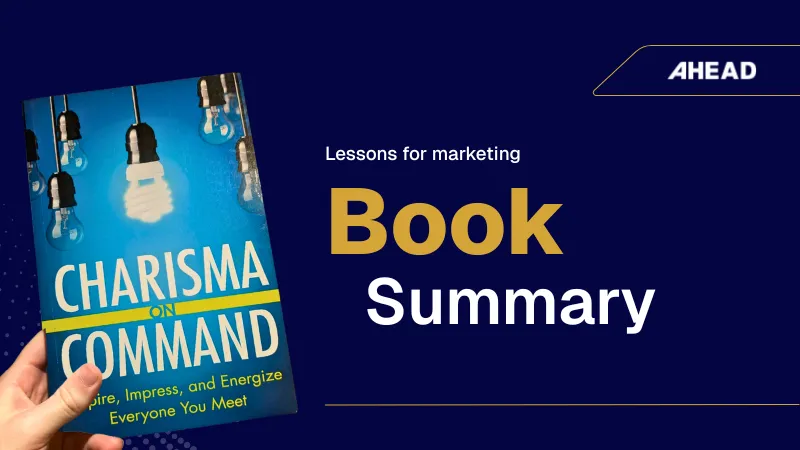
Charisma on Command is Charlie Houpert’s short, practical guide to being more magnetic in conversation. It treats charisma as a set of habits you can practise rather than a gift you either have or don’t. This summary covers the book’s main framework, the lessons I find most useful, and how to use them in the three places charisma pays off for a small business: client meetings, sales calls and video marketing.
Skill and strategy earn you the chance to pitch. How people feel while they’re talking to you, in the room, on a Zoom call or watching your Instagram reel, often decides whether they buy.
Key takeaways
Charlie Houpert wrote Charisma on Command: Inspire, Impress, and Energize Everyone You Meet. It was first published in 2014 through CreateSpace, Amazon’s self-publishing platform (Texas A&M University Libraries record; Goodreads).
Houpert is best known as the co-founder of the Charisma on Command YouTube channel, which breaks down how celebrities, politicians and film characters hold a room. He started studying charisma to get past his own social anxiety, and he later bought out his co-founder to run the business alone. In a 2025 interview on Tim Ferriss’s blog, the channel is described as having more than 10 million subscribers, and the business began life as a “muse”, the low-maintenance online business idea from The 4-Hour Workweek.
The book is sometimes credited to Vanessa Van Edwards, but she is a different author. Her books on the same subject are Captivate (2017) and Cues (2022), both published by Penguin Random House.
Charisma is not a personality type. It is the effect you have on other people, and you produce it through things you can see and change: what you believe about yourself, the energy you bring into a conversation, and how you present it through your voice, body and stories. Houpert points out that most people are already charismatic with close friends. The work is getting that version of you to show up on demand, with strangers, clients and an audience. Rather than memorising lines, you build a few core beliefs, practise one visible skill at a time and let the results compound.
The book’s core model is that charisma comes from three ingredients working together. Take one away and the effect breaks. Confident body language with no real belief behind it reads as an act, and strong belief delivered in a flat monotone gets ignored.
The book is short and moves from mindset, to technique, to a practice plan. Here is its shape in brief, in my own words.
Sets out the three-part model above and argues that each part can be trained on its own.
A set of beliefs that sit underneath confident behaviour: being at peace with yourself whatever the outcome, caring more about your character than other people’s opinions, keeping your word, not needing everyone to agree with you, and being willing to go first. For business owners, the most useful is making fewer promises and keeping every one of them.
Leadership starts small: saying what everyone in the room is thinking, naming an awkward silence, or suggesting the next step while everyone else waits.
Houpert pushes back on the classic advice that you only need to be interested in other people. His view is that you earn attention by being interesting, through stories and opinions, and then hand the spotlight back so the other person feels seen.
Practical chapters on posture, eye contact, gestures, vocal range, filler words and storytelling. One idea transfers straight to marketing: one person’s story moves people more than a statistic about thousands.
The book closes with a 30-day plan of daily drills, each focused on one observable behaviour, followed by a self-assessment. The message is that there’s no single breakthrough moment, only steady practice.
The seven lessons below are the ones I’ve found most useful in client work. Some come straight from the book and some from the wider Charisma on Command material.
Before you say a word, people are already forming an opinion. In those first moments:
Bring energy that makes others smile: enthusiasm is contagious.
Eye contact and a genuine smile are essential.
Introduce yourself with a light touch. A confident handshake or fist bump makes the interaction feel warmer.
Have a few simple starter questions ready: Where are you from? What do you do?
In marketing terms, your “first impression” is your brand’s opening line, whether in an ad, email subject line, or sales call.
Use it in business: in a client meeting, stand up, smile and use the person’s name before you open the laptop. On a sales call, lead with a specific question about their business rather than your credentials. On video, the first two seconds are your handshake: look into the lens and start with your point, not a long hello.
Great conversations don’t stay on the surface. Ask why someone did something. Then ask why again. People open up when they talk about what matters to them. Spot their core values, desires, and motivations, and show you care.
In a business setting, this is how you uncover your client’s true drivers, beyond the brief. The more you understand their values, the more you can position your service as the perfect fit.
Use it in business: on a discovery call, when a prospect says they want more leads, ask why that matters now. The second or third answer (“the van sits idle on Thursdays”, “I want to stop working weekends”) is the real brief, and it’s the line to repeat back in your proposal.

Download your free copy of our guide for attracting quality leads and growing your business.
You don’t have to feel confident to act confident: your body can lead your mind.
Stand tall, use open gestures, move with purpose.
Recall moments you’ve felt your best.
Use positive self-talk and affirmations.
In marketing, this is about delivering your message with conviction. A lukewarm pitch rarely inspires trust; confident, clear communication does.
Use it in business: before a pitch or a recording, spend two minutes standing tall and saying your opening out loud. State your price plainly and then stop talking. Hedging (“it’s around this, but we can be flexible”) tells the buyer you don’t quite believe in it either.
Charisma isn’t about dominating the conversation; it’s about creating space for connection.
Lower your filter; don’t overthink every sentence.
Offer multiple conversational paths.
Use light humour: references, playful tone, gentle teasing.
Create open loops to keep curiosity alive.
Great marketers do the same in copywriting and content, leaving the reader wanting to know more.
Use it in business: in meetings, offer easy threads to pull (“I was on a site visit in Woking this morning, actually”). In emails and ads, an open loop is a subject line or hook that raises a question the rest of the message answers.
A story isn’t just information; it’s emotion in motion.
Know your purpose: why you’re telling it.
Build intrigue before the punchline.
Keep it playful, deliver with energy.
In sales or marketing, stories make data memorable and brands relatable.
Use it in business: swap your “about us” paragraph for one short customer story: the problem, the moment it got worse and what changed. It works on a sales call, in a case study and as a 30-second reel. If you want a structure, the StoryBrand framework pairs well with Houpert’s delivery advice.

Contact us for a bespoke initial review of your website marketing efforts.
How you speak matters as much as what you say.
Strengthen your voice with diaphragm breathing.
Speak with clarity and volume, but never rush.
Focus on your message, not how you’re being judged.
Use it in business: record yourself on a practice call or a draft video and listen back once. Most people spot two habits straight away: a rising tone at the end of statements, which sounds unsure, and filler words. Fix one at a time. A pause before your key point does more than speaking louder.
The most magnetic people aren’t faking it; they’re aligned with their values:
Certainty: believe in what you offer.
Growth: keep learning.
Contribution: bring genuine value.
Connection: build trust, not just transactions.
Significance: stand out for the right reasons.
Daredevil mindset: take calculated risks and have fun.
This list closely mirrors Tony Robbins’ six human needs, and reviewers have noted that some of the book’s exercises borrow from Robbins too. Either way, the business point stands: if you don’t believe your service is good value, no technique will hide it. Fix the offer first, then work on delivery.
The same three ingredients show up differently depending on the setting. This table is how I translate the book into the situations a small business owner faces every week.
| Skill | Client meeting | Sales call | Video marketing |
|---|---|---|---|
| Conviction | Recommend one clear option instead of listing five | State your price without apologising | Pick one opinion per video and commit to it |
| Energy | Match their mood first, then lift it slightly | Smile while you talk; people can hear it | Record standing up, a notch livelier than feels natural |
| Eye contact | Hold it while they talk, not only while you do | On Zoom, look at the camera when you make your key point | Look into the lens, not at your own face on screen |
| Voice | Slow down and pause before the important bit | Drop your tone at the end of statements | Cut filler words in the edit, keep the pauses |
| Story | Open with a similar customer’s problem | Use one short example, not a client list | Lead with the moment the problem hurt |
| Attention | Ask why twice before you pitch | Summarise their words back to them | Talk to one viewer as “you”, not to “everyone” |
You don’t need to be on stage to use this book. Here’s how three typical UK small businesses could put it to work this month.
Conviction means giving one recommended option and a clear price, not three vague ones. Energy and presence mean arriving on time, looking the homeowner in the eye and explaining the work in plain English. For story, mention a similar job, the problem you found behind the tiles and how you sorted it. The same two minutes, filmed on a phone, make a good short video for your Google Business Profile or Facebook page.
Here the charisma is mostly the team’s. Train staff to make eye contact and greet regulars by name, because that warmth is what customers mention in reviews. On Instagram, the owner talking to camera about where the beans come from usually feels more personal than a polished product shot, as long as they speak to one viewer and keep it short. Our social media advice for small businesses covers what to post.
Accountants often lose prospects by sounding like every other firm. Ask why twice to find the real worry (cash flow in January, dread of a letter from HMRC), then reflect it back in the prospect’s own words. Record a short weekly video answering one common client question. The book’s advice on pace, pauses and filler words matters more than lighting or kit.
Here’s an illustrative first call for a kitchen fitter, the kind of enquiry a Google Ads campaign brings in every day.
Before: The fitter answers on the sixth ring with a flat “Hello?”, lists every service they offer, then quotes a wide price range in a hesitant tone. The caller says they’ll think about it and rings the next firm.
After: The fitter answers with their name and business, with a smile you can hear. They ask what prompted the call, then ask why the timing matters (“we’ve got family staying at Christmas”). They share a 20-second story about a similar kitchen finished before a deadline, recommend one next step, a home visit on Thursday, give a clear starting price and then stop talking.
Nothing about the offer changed. The second call simply has conviction (one clear recommendation), energy (a warm opening) and presentation (a relevant story and a confident close). If your calls come from paid ads, track which ones turn into bookings so you can see whether the changes work. Our guide to setting up conversion tracking in GA4 explains how.
This is my business version of the book’s practice idea: one habit per week, used in real conversations.
Week 1: openings
Practise your first ten seconds: name, smile, eye contact and one good question. Use it on every call.
Week 2: questions
Ask why at least twice in every discovery conversation and note what you learn.
Week 3: stories
Write three 60-second customer stories and use one in each meeting.
Week 4: voice and video
Record two short videos, watch them back and fix one habit each time.
The book is a good starting point, but it isn’t the last word on charisma. Here’s a fair view of where it’s strong and where it falls short.
Strengths
Limitations
Read it if you’re a business owner, freelancer or salesperson who knows your trade but feels flat in meetings, on the phone or on camera. It’s especially useful if you’re starting to make videos for your business and feel stiff in front of the lens. If you’re naturally quiet, take the techniques and ignore the pressure to be loud; warmth and attention matter more than volume. If you already feel socially confident and want the research behind persuasion, start with Cialdini instead.
The core lesson of Charisma on Command is that charisma is a set of habits built from conviction, energy and presentation, and every one of them can be practised. For a small business, that means warmer first meetings, discovery calls that uncover what clients really want, and videos where you sound like yourself.
If strategy wins the contract, charisma keeps it. But charisma only works on the people who reach you; it can’t create the enquiries in the first place. If you’d like more of the right people calling, our Google Ads management and SEO services are built for UK small businesses. Get in touch for a no-pressure chat, in person if you’re near Guildford.
About the author
Howard Head is the founder of Ahead Marketing, a digital marketing agency based in Guildford, Surrey. He has five years of agency SEO experience at Improve My Search Ranking, working on more than 180 client campaigns, and has trained with Backlinko, SEO Blueprint, Clickslice and Google. More about Howard.
Charlie Houpert wrote Charisma on Command: Inspire, Impress, and Energize Everyone You Meet, self-published in 2014. He co-founded the Charisma on Command YouTube channel, which analyses how well-known people hold attention, and now runs the business on his own.
No. Charisma on Command is by Charlie Houpert. Vanessa Van Edwards is a separate author who runs Science of People and wrote Captivate (2017) and Cues (2022), which cover similar ground with more emphasis on research.
Houpert breaks charisma into conviction, energy and presentation. Conviction is what you believe about yourself and your message, energy is the mood you bring and pass on, and presentation covers voice, posture, eye contact and storytelling.
Yes, if you want a short, practical introduction to social confidence. It’s easy to act on and comes with a 30-day practice plan. It’s weaker on research and favours a high-energy style, so quieter readers should adapt the techniques rather than copy them.
Different authors split charisma differently. Olivia Fox Cabane’s The Charisma Myth describes presence, power and warmth, while Houpert’s book uses conviction, energy and presentation. Both agree that charisma is a set of behaviours rather than a fixed trait.
That’s the central claim of the book, and most writers on the subject agree. You improve it the same way as any skill: pick one visible behaviour, such as eye contact or pausing before your key point, practise it in real conversations and review how it went.
Look into the lens rather than at yourself, talk to one viewer as “you”, and start with your point instead of a long introduction. Record standing up with slightly more energy than feels natural, then cut filler words in the edit. Our social media advice for small businesses covers what to film.

Marketing with standards.
Learn the simple steps to more customers. Download your free copy of our guide for attracting quality leads and growing your business.
Get your free website marketing health check. Contact us for a bespoke initial review of your website marketing efforts.
Prefer to message? Chat live now in the bottom corner.
Data-driven marketing to elevate the standards of internet marketing.
This site is protected by reCAPTCHA and the Google Privacy Policy and Terms of Service apply.